Science Fiction Imagination Classroom Enters Ningbo
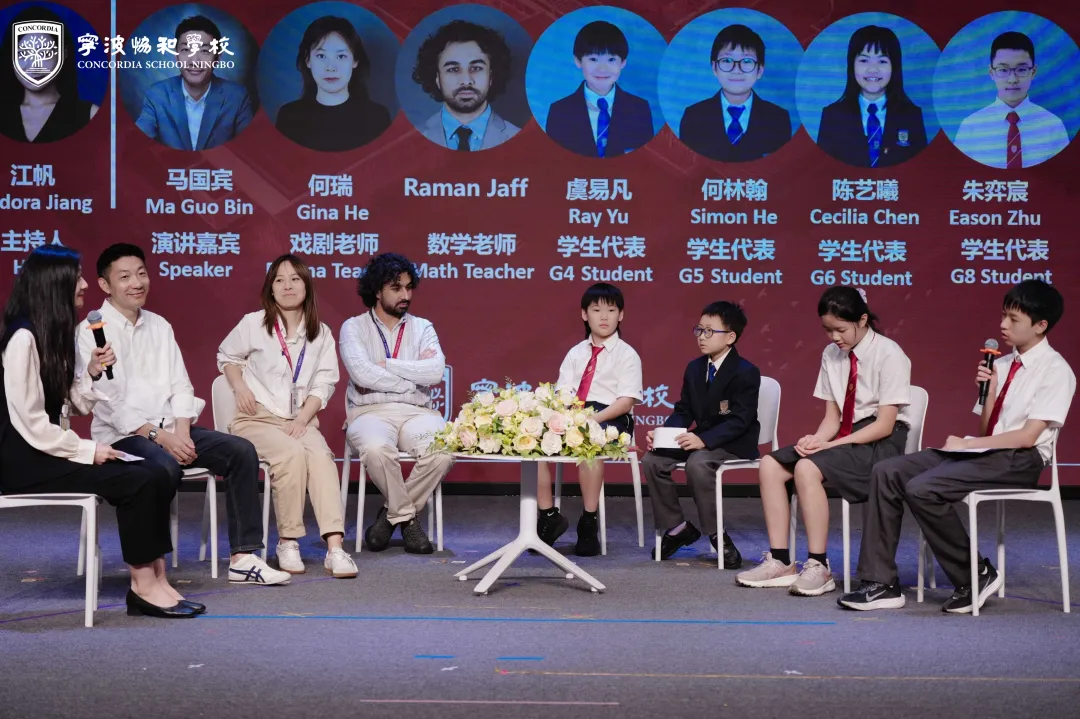
When it comes to science fiction, what comes to mind may be the Dark Forest Law in "The Three Body Problem" or the wormhole theory in "Interstellar"; But when it comes to Chinese language education, most people still think of Chinese reading as ancient poetry, Lu Xun, and good lyrics and paragraphs. Few people believe that science fiction novels should be read as exemplary literature. But did you know that science fiction has long been the key to breaking the boundaries between IB Chinese and Mandarin Chinese? It not only allows children to actively fall in love with reading, but also quietly cultivates IB's emphasis on "critical thinking" and "global perspective", as well as the "humanistic heritage" and "creativity" pursued by Mandarin Chinese.
On the day of the iPhone 17 PRO launch event, the dialogue between Ningbo Concord on technology and the future is even more noteworthy, as we are more cutting-edge from an innovative perspective.
Ma Guobin, the initiator of the SCIENCE & FANTASY GROWTH FOUNDATION, leads children to pay attention to many science fiction achievements in human history: when was the first moon landing?
Many children gave the correct answer in 1969, but Teacher Ma told everyone that as early as 104 years before humans landed on the moon, Jules Verne depicted the scene of three Americans landing on the moon; Next, Teacher Ma showed everyone the handheld communication devices from Star Trek. It's hard for the children to imagine that 7 years after the movie aired, in 1973, Motorola produced the first generation of "mobile phones", which were widely used by humans for only 30 years; In addition, Teacher Ma also asked the children to guess what kind of car was in the 1982 TV series "Thunderbolt Rangers"? The children guessed GTR from Ferrari, but no one answered that it was a 'self driving car'.
Teacher Ma Guobin uses these simple and easy to understand examples to tell children how technology has changed human vision, how the transition from nature to science fiction is carried out in what industrial forms, what business models operate, and how it affects our world.
Finally, he mentioned the science fiction logic of 'what if', which is precisely the critical thinking emphasized in IB education. Based on existing conditions, how can we reasonably speculate on the occurrence of events and make innovative constructions.
During the roundtable forum, Chinese teacher Jiang Fan, who had previously taught several IB high scoring students, asked questions to both teachers and students from an educational perspective.
Q: What scientific theoretical knowledge is needed to become a science fiction writer, and how does science happen in science fiction?
Teacher Raman said: Fantasy makes us pay attention to history, the past, and the causes of things' development, while science fiction takes us from the past to the future. Mathematics and physics have always been able to provide us with methods and theoretical support for exploring the universe and the world. Just like Eason, me, and a point behind the venue, Eason can make a triangle to measure distances that we cannot measure by measuring the distance and angle between him and me. This model can be scaled up to many other models. Learning scientific knowledge enables us to better create science fiction works.
Q: What are the theatrical adaptations of science fiction works and how can they be integrated with our discipline?
Teacher Gina: Drama and science fiction are both deep reflections of human beings. I pay attention to the ethical considerations of technology, such as the popular "Bouquet for Algernon" in recent years, which tells the story of a bakery worker who, after participating in an "intelligence enhancement experiment," experiences a surge in intelligence but returns to the starting point due to experimental side effects. The protagonist has experienced the world's unhappiness perceived through increased intelligence, such as social apathy and selfishness, while also facing the regret of "having and then losing". I think we all had this fear when we were children - if gene editing were possible, would parents and society choose a higher version of us with higher intelligence? I think through drama, the new generation can more intuitively feel the theme of love, and they may think, "If I eventually forget, I hope I remember I tried hard and was loved". Science should be warm.
When mentioning the original intention of organizing this science fiction forum, Teacher Jiang said that IB Chinese focuses on in-depth exploration from an international perspective, while Big Chinese is a comprehensive literacy rooted in culture. Science fiction can seamlessly connect the two.
Science fiction can bring Chinese language to life: for example, when reading "Folding Beijing", children will naturally associate it with "social stratification and fairness", and when reading "Don't worry about scarcity, worry about inequality" in "The Analects", they can understand the practical significance of classic ideas. When children read 'The Three Body Problem', they will think about the 'position of human civilization in the universe', which is exactly what IB advocates for 'cross-cultural understanding and responsibility'. From focusing on words to focusing on humanities, this is also the core value of Chinese language.
After reading 'Rural Teachers', one of my students became interested in the meaning of education and came up with the story of' using technology to help children in remote areas'. This transition from 'reading' to 'thinking' is far more valuable than achieving high scores on exams.
I also hope that if parents see their children holding science fiction books, they can ask them what kind of world they see - because the ultimate goal of Chinese language education is never to "teach children to remember", but to "teach children to understand the world and express themselves".